
Japanese Fans Are Picking Up Trash Again After Major Sporting Events
Japanese fans are picking up trash again after the final whistle, turning stadium exits into scenes of quiet public service rather than hurried disorder. At recent international football matches in Tokyo and Osaka, supporters carried plastic bags through the stands, gathered drink cups, food wrappers and paper flags。then separated the waste before leaving. Japanese fans are picking up trash again, a phrase that has circulated widely on social media whenever images of orderly supporters emerge from major events. The behavior is familiar to many residents, but it continues to attract international attention because it appears spontaneous. There is no visible line of workers directing each person, and no reward waiting at the gate. Fans simply pause, look under seats and place stray rubbish into bags they brought from home or received from volunteers.After one evening match at Tokyo’s National Stadium, a group of university students stayed behind for nearly fifteen minutes while commuters streamed toward nearby stations. One student, wearing a blue team scarf, used a folded program to scoop up popcorn kernels from the concrete. Another checked the row beneath the seats, where a crushed bottle had rolled into the shadows. “It feels strange to leave it for someone else” he told a local reporter. Japanese fans are picking up trash again, but the gesture is less a sudden trend than a visible part of civic education and group etiquette. Children are taught to take responsibility for shared spaces, while schools often assign cleaning duties to students. Those routines can follow people into adulthood。especially in places where public bins are limited and littering is treated as a breach of social trust.
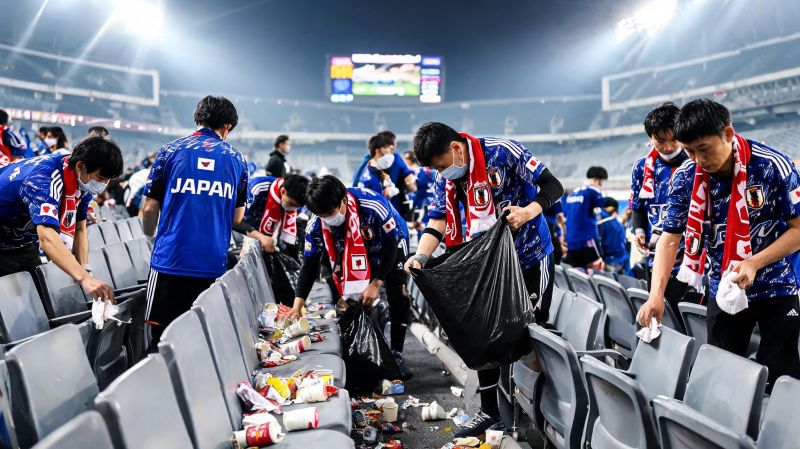
The practice became globally recognizable during the 2018 World Cup in Russia, when Japanese supporters cleaned their sections after matches and the national team left its dressing room spotless. Similar images appeared during the 2022 tournament in Qatar, prompting praise from international broadcasters and millions of online users. Japanese fans are picking up trash again has since become a recurring headline, sometimes used as shorthand for Japan’s public manners. Yet the attention can flatten a more complicated reality. Japan still produces large amounts of packaging waste。convenience stores remain dependent on individually wrapped products, and overflowing bins appear at festivals and train stations. A clean stadium does not prove that every environmental problem has been solved. It does show how powerful social expectations can be when a crowd decides that responsibility belongs to everyone.Organizers are also shaping the conditions for the ritual. Stadium staff place collection points near exits, volunteers explain how to separate cans and bottles, and fan clubs distribute small rubbish bags printed with team colors. At concerts and baseball games, cleanup campaigns are sometimes linked to community groups that collect recyclable materials for local projects. Japanese fans are picking up trash again in these settings because the action has become part of the event’s emotional rhythm: celebrate。wait for the crowd to thin, then restore the space. Some supporters say the habit began with parents;others learned it from television coverage of overseas matches. The motivation varies, but the result looks much the same. A child watches an older fan bend down, and a few seconds later starts searching beneath the seats too.There is also a practical lesson in the scenes. Public behavior is rarely shaped by slogans alone. It is shaped by what people see around them, by whether the right bags and bins are available。and by the belief that neighbors will notice if a space is neglected. Japanese fans are picking up trash again, yet the strongest message may not be about national exceptionalism. It is about repetition. When thousands of people perform a small task together, the task becomes normal, even satisfying. Critics may argue that foreign media romanticize Japanese supporters, and they have a point;no society is uniformly tidy. Still, watching fans leave a stadium cleaner than they found it offers a concrete picture of shared accountability. The applause may end at the final whistle, but the civic habit continues in the aisles.
Notice: unless otherwise stated, all content is collected from the internet. If it infringes your rights, please contact us for removal.